My Hopefully Definitively Interesting Views

  • My 10 Minute Guide to “X”‘s and “Meta”‘s Current Misinformation Policies

    My 10 Minute Guide to “X”‘s and “Meta”‘s Current Misinformation Policies

    American public discourse was different before 2006. Before then the people used a physical place known as a “town-square” to socialize ideas, and then decide on beliefs and policy by communal consensus. The foundations of these town-square discussions were  based on curated information propagated mostly by the news media, religious beliefs, and formal education. But for the past 20 years, the town-square space has digitally migrated into a near-infinite-square space facilitated mainly by the social media platforms “X” (formally known as Twitter), and “Facebook”. What does that mean?

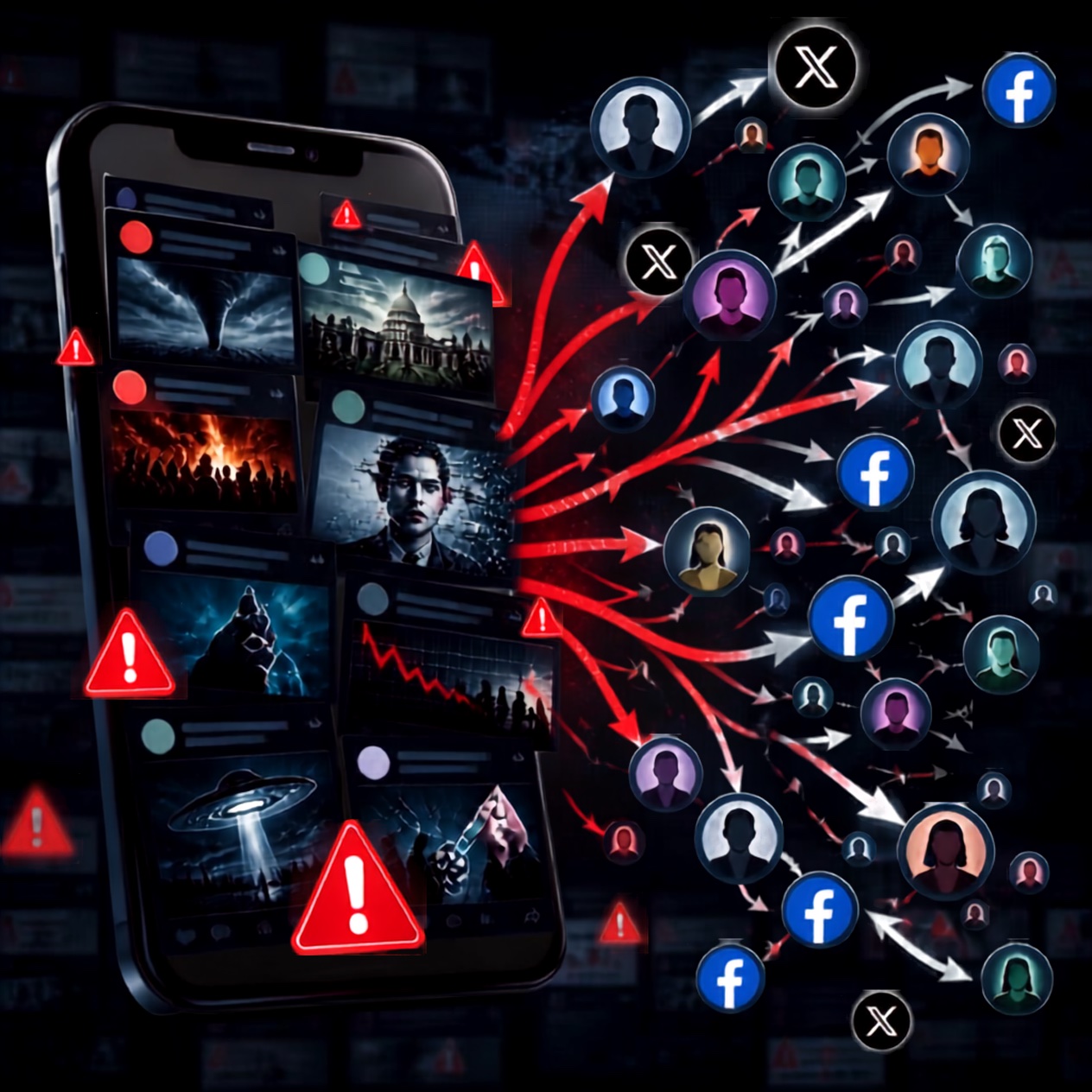
                Both X and Facebook are private social media platforms with not just national, but global reach whom allows every person, or entity with an account the capability to reach the masses. As such, the conversations surrounding the information being added, distributed, and consumed on these social media platforms is very broad and can easily be manipulated. What that means is that bad and/or ignorant actors have an outsized impact on shared beliefs, policies, and ultimately social consequences. Furthermore, bad actors such as (but not limited to); grifters, enemy corporate entities, and enemy state actors (just to name a few) effectively disseminate misinformation by convincing unassuming members of X and Facebook to mass circulate their material by aligning personal identity or strong social belief with something novel that elicits a strong emotion. Moreover, because this issue has become so increasingly unmanageable, X and Facebook are continually adapting policies, methods, and practices attempting to shore up damage created by bad actors with concern to the spread of misinformation. Let’s examine what they are up to…

                I am going to start with X. X’s primary defense against misinformation is Community Notes, which is a crowdsourced system where contributors contextualize posts, and notes only go public once raters (holding differing viewpoints) agree they’re helpful (in 2026 X began testing AI-drafted notes that humans then refine collaboratively, the jury is still out). It appears the approach holds merit, as community notes broadly reduce the spread of misleading posts (once annotated), lowering total engagement with misleading posts by about 14.9%. Furthermore,  a review of COVID-19 vaccine-related notes found medical professionals rated 98% as accurate.

     Transversely, the Notes system itself is a reactive system. While a whopping 99.3% of misleading posts get debunking comments on other platforms within two hours, Community Notes take an average of 24.29 hours. What that means is that by the time a note publishes, the misinformation post has typically already reached 80% of its audience. Moreover, coverage is thin too  as 91% of posts with a proposed note never get one rated “helpful,” and the helpful-note rate fell from 13.1% in 2024 to 8.2% in 2025 alongside declining contributor retention, bringing into question sustainability. How does this compare to other major platforms?

     This path isn’t completely unique to X. Meta ended third-party fact-checking in the U.S. in April 2025 for its own Community Notes-style system, although it’s worth mentioning that Meta’s notes don’t limit a post’s reach. Meanwhile, TikTok launched a similar “Footnotes” feature in 2025, in a way making crowdsourced moderation an industry standard. Some improvements researchers suggest include speeding up early intervention (speed of dissemination is clearly the largest hurdle), pairing ideologically diverse contributors to jointly write notes, publishing more transparency data for independent research, and retaining a model that keeps expert fact-checkers involved.. Overall, Community Notes measurably helps but remains too reaction oriented (thus slow) and narrow to be a complete solution. Now let’s look at Facebook (which I will call Meta from here on out because it is the overarching entity that dictates policy). 

    Meta’s approach to handling misinformation shifted dramatically when it ended its third-party fact-checking program across Facebook, Instagram, and Threads in the U.S. in April 2025. Fact checking was replaced with a Community Notes system modeled on X’s which used (is using) user-submitted context that only goes public once contributors with differing viewpoints agree it’s accurate, and which, in contrast to the old system, does not limit a flagged post’s reach. Furthermore, Meta has since expanded the feature with alerts, note requests, and helpfulness ratings, while planning to extend it beyond the United States.

     However, early results yield similar yet worse bottlenecks than experienced on X. To begin with, over 70,000 contributors have written approximately 15,000 notes, yet just 6% have been published. Meta’s own prior fact-checking system reduced the visibility of false posts by more than 80%, and analysts estimate Meta would need around 2.5 million contributors for Community Notes to reach comparable effectiveness at current scale (and that’s a standard they are nowhere near). For example, the Center for Democracy and Technology has warned specifically about low reach on election misinformation, and researchers note the model may struggle further on visual platforms like Instagram or inside closed groups, where crowdsourced review is harder to apply. Moreover, a German research institute’s 2025 study concluded plainly that Community Notes “cannot substitute for transparent content moderation.”  It appears that the clearest fixes mirror those for X. First, be transparent with data in relation to the public. Second, invest heavily in contributor recruitment (still have to figure out the massive scale gap Meta faces). Third, figure out a way to build in faster early-stage intervention given delays let posts go viral before correction. And lastly, preserve some hybrid role for expert review,  specifically for things like elections, basic science, and public health rather than replacing professional fact-checking wholesale with an unproven volunteer system that is still establishing a foundation.

                In summation, it seems that both X and Meta have, and are currently, employing a misinformation defense system that is reliant on differing members of the town-square to check one another. However, it appears that we have a long way to go before finding a viable solution that effectively curbs the problem. 
  • A Brief Walkthrough of Current Misinformation Education Platforms

    A Brief Walkthrough of Current Misinformation Education Platforms

    Greetings from coastal North Carolina where I have been exploring and/or playing around with two distinct, and very different, online misinformation learning tools. The first is a service named RumorGuard. Published by the News Literacy Project, RumorGuard is a website dedicated to rooting out, analyzing, and assisting the public understand misinformation. The second website is an online game in which the player is encouraged to both manage finances and earn money by creating media driven social media posts that elicit emotional responses by by members of ideologically driven social media groups. Given that preface, let’s survey these educational resources and their possible applications. 

    RumorGuard.

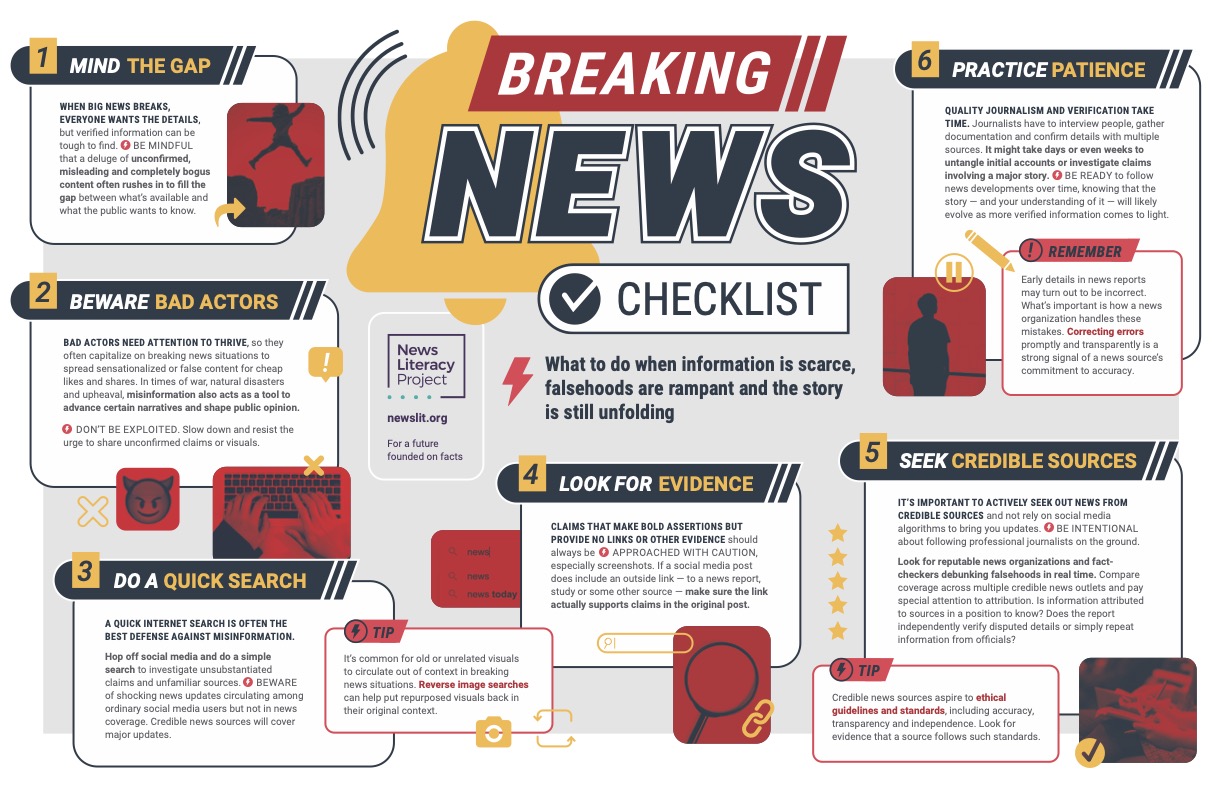
    As mentioned in the intro, RumorGuard is an online tool created with the intent of neutralizing misinformation.  But more than that, it is a tool that offers educational material to anyone who wants to buttress their ability to recognize misinformation. The RumorGuard website contains four distinct performance sections that anyone can navigate to.

    RumorGuard.

    As mentioned in the intro, RumorGuard is an online tool created with the intent of neutralizing misinformation.  But more than that, it is a tool that offers educational material to anyone who wants to buttress their ability to recognize misinformation. The RumorGuard website contains four distinct performance sections that anyone can navigate to.

    1.) The “Recent Checks” section offers a number of current stories, threads, and visual media (images and videos) circulating on various media platforms that have been labeled as misinformation. 

    2.) The “Factors” section educates a five-pronged approach to verifying information; authenticity, source, evidence, context, and reasoning. In addition, this section contains multiple tutorials providing techniques in which to identify misinformation. 

    3.) The “Topics” are a hash tagged section that categorize the types of misinformation discovered by the site when exposing media. 

    4.) Lastly, the “Take Action” section offers ways for people interacting to learn, dig deeper, offer feedback, and yes even donate. 

    The interactive learning tool created by RumorGuard should be regarded as a very effective tool for not just sifting through media for misinformation, but for providing a rudimentary system  that equips an individual for the autonomous competency to discern misinformation that utilizes five separate units of classification; Source, evidence, context, reasoning, and authenticity.

    In review, the interactive tool that RumorGuard provides is most helpful in recognizing modern social-media based information (and misinformation specifically). Furthermore, a study published by the “International Journal of Inclusive Education” found that “access  to digital platforms correlated with high academic achievement, while interactive tools were associated with improved student satisfaction.

    The Fake it to Make it Game.

    Alright, let’s dive in to the interactive online game “Fake it to Make it”. A product created by Amanda Warner for ‘Games for Change”, this game is a role-playing type platform in which the goal of the experience is to make as much profit as possible by personally spreading misinformation through social media websites. 

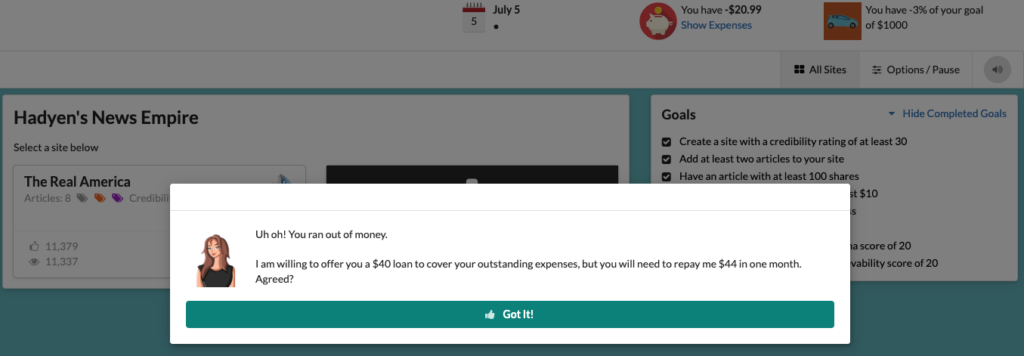
    After setting a financial goal, naming a character, and naming your website/business, you will quickly notice that you have a finite amount of money. This is important because the game uses time-bound financial stressors to encourage the rapid creation of media articles aimed at accumulating social media revenue. Below is a screenshot of me going into debt whilst chasing my dream!

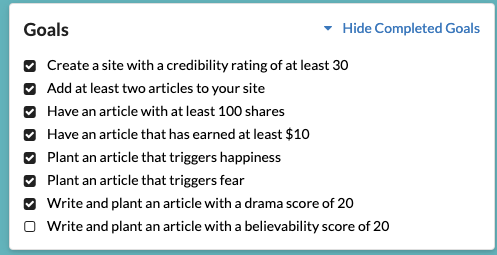
    For the duration of gameplay, the operator is thus encouraged to pump out as many emotionally triggering articles as possible in order to generate revenue. Many of the next steps needed for success are prompted by that same money lender. As the player, you can acquire articles for social media monetization in two different ways; you can either copy another’s article and post, or write your own. The idea here is to post as many articles as you can while covering the most emotional responses possible, while meeting certain goals imbedded in the programming. 

    The educational effectiveness in “Fake it to Make it” exists in the platform’s ability to incentivize the user, who more than likely never considered why and how misinformation is being created, to experience both the monetary pressures and the morally flexible ease by which misinformation is propagated. Furthermore, while it won’t be able to eradicate misinformation, video games such as this one certainly create training regimens that exist in a motivational context that benefits the individuals ability to quickly identify (or transversely create) misinformation.  

  • My Daily Media Consumption- A Linear Track of my Ingestion/Regurgitation

    My Daily Media Consumption- A Linear Track of my Ingestion/Regurgitation

    What is the purpose of this article? To give my readers a glimpse of  my linear media consumption on Friday, August 28, 2026. That being said, I am a fairly idiosyncratic user concerning today’s information space. For instance, I do not use social media per se and, in my opinion, most newspaper articles lack way too much context. The same goes for the sound bite legacy television news media. I likewise spend a decent amount of time debating AI, sometimes seriously and sometimes just to see if I can get the AI frustrated enough to stop responding to me. But enough about all that…

    4:15 AM: I Roll my body out of bed, get a workout in, freshen up, kiss the family goodbye, and pull out of the driveway work by 5:30 AM. The commute to and from work is approximately 45 minutes, and typically (unless I want to indulge in music) that’s my to listen to lectures, audiobooks, or podcasts. As it turns out, Friday was a podcast day. 

    5:30 AM: As a podcast day, and at the behest of my best friend whom we shall call Larry (that’s not his real name, and he is an incredibly intelligent person) I decided to listen to the “Owen Report”. This podcast is hosted by a dude named Owen Shroyer who was extrajudicially imprisoned for six month after the events on Capitol Hill on January 6th. This podcast is a whopping three hours long. I got through 45 minutes on the drive to work and another 30 minutes while I was preparing reports and doing all of the pre-workday things required of a military leader. 

    6:45 AM: I’ll say, that first 20-30 minutes was very informative (possibly with the intention for building a foundation for misinformation and disinformation). I learned that the Karoline Leavitt is going to be a guest on “The View” after her falling out with the Trump Administration (not quite sure how this qualifies as news worthy). I also learned that the U.S. added 79,000 fewer jobs than previously reported in March of this year. After a few more news headlines, Owen Shroyer spent the next hour and half (probably the next three but I can only speak to an hour and a half) raising talking points, and subsequently explaining how that information points to the “fact” that the United States are the puppets of Israel, and that Israel is using the U.S. as an ultimate means of global dominate subjugation. Further, I’m not quite sure if this is misinformation, or disinformation, the intent is very blurry. I was also so busy for the rest of the day that I forgot to eat, and media consumption was nonexistent (except for music, and if I would have thought of it, I would have written down lyrics and analyzed). If you want to know what I am explaining, the link to the podcast is below.

    https://rumble.com/v7es506-karoline-leavitt-to-the-view-milo-detained-by-ice-fake-nfl-players.html?e9s=src_v1_cmd%2Csrc_v1_ucp_a

    5:30 PM: Leaving work! Time for my drive home podcast. I chose to go with yesterday’s installment of the Skeptics Guide to the Universe (SGU). This podcast is a good counter to the misinformation and disinformation that is peddled in the information space. The podcast gifts solid tools for critical thinking, promotes healthy skepticism, and teaches a ton about what is going on in modern science and health. For instance, I learned a lot about encephalopathy, including that a recent study found that 25% of NFL players that died from 2016-2021 suffered from chronic traumatic encephalopathy (CTE). My only negative critique of the SGU is that, when they touch on politics, the critical thinking skills and curious mindset kind of goes away and they devolve into an idea echo chamber. 

    7:30 PM: Ahhhh; dinner was eaten, kitchen was clean, animals got fed, helped daughter with homework, uniform readied for tomorrow, and lunch was packed for the next day.  I sat down to watch an episode of “Game of Thrones” with the wife. Upon reflection, I learned a few things. One, that a good story is very, very addictive and humans just can’t get enough. Two, the overarching thematic message in the show seems to be that most leaders will seek to achieve their goals of power, or revenge, or their own sense of justice by any means necessary. Also, we are watching on HBO Max, which means there are commercials, and it’s all the same GLP-1 commercial. So I am now very aware that GLP-1s are the most convenient ways of losing weight. 

    9:30 PM: Alright, the day was done and it was time to turn in. Usually I read before bed but I was too tired. 

  • Insights with Danny

    Check out the Latest and Greatest