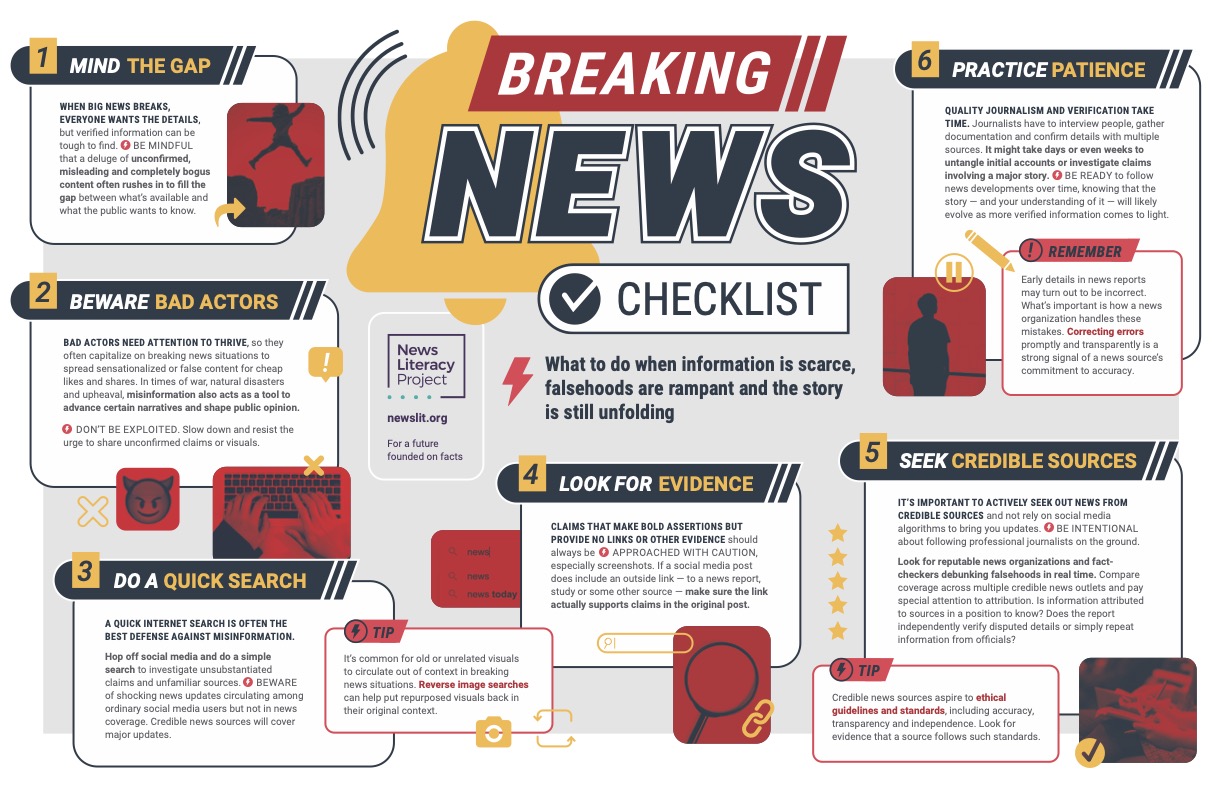
Greetings from coastal North Carolina where I have been exploring and/or playing around with two distinct, and very different, online misinformation learning tools. The first is a service named RumorGuard. Published by the News Literacy Project, RumorGuard is a website dedicated to rooting out, analyzing, and assisting the public understand misinformation. The second website is an online game in which the player is encouraged to both manage finances and earn money by creating media driven social media posts that elicit emotional responses by by members of ideologically driven social media groups. Given that preface, let’s survey these educational resources and their possible applications.
RumorGuard.
As mentioned in the intro, RumorGuard is an online tool created with the intent of neutralizing misinformation. But more than that, it is a tool that offers educational material to anyone who wants to buttress their ability to recognize misinformation. The RumorGuard website contains four distinct performance sections that anyone can navigate to.

RumorGuard.
As mentioned in the intro, RumorGuard is an online tool created with the intent of neutralizing misinformation. But more than that, it is a tool that offers educational material to anyone who wants to buttress their ability to recognize misinformation. The RumorGuard website contains four distinct performance sections that anyone can navigate to.
1.) The “Recent Checks” section offers a number of current stories, threads, and visual media (images and videos) circulating on various media platforms that have been labeled as misinformation.
2.) The “Factors” section educates a five-pronged approach to verifying information; authenticity, source, evidence, context, and reasoning. In addition, this section contains multiple tutorials providing techniques in which to identify misinformation.
3.) The “Topics” are a hash tagged section that categorize the types of misinformation discovered by the site when exposing media.
4.) Lastly, the “Take Action” section offers ways for people interacting to learn, dig deeper, offer feedback, and yes even donate.
The interactive learning tool created by RumorGuard should be regarded as a very effective tool for not just sifting through media for misinformation, but for providing a rudimentary system that equips an individual for the autonomous competency to discern misinformation that utilizes five separate units of classification; Source, evidence, context, reasoning, and authenticity.
In review, the interactive tool that RumorGuard provides is most helpful in recognizing modern social-media based information (and misinformation specifically). Furthermore, a study published by the “International Journal of Inclusive Education” found that “access to digital platforms correlated with high academic achievement, while interactive tools were associated with improved student satisfaction.
The Fake it to Make it Game.
Alright, let’s dive in to the interactive online game “Fake it to Make it”. A product created by Amanda Warner for ‘Games for Change”, this game is a role-playing type platform in which the goal of the experience is to make as much profit as possible by personally spreading misinformation through social media websites.
After setting a financial goal, naming a character, and naming your website/business, you will quickly notice that you have a finite amount of money. This is important because the game uses time-bound financial stressors to encourage the rapid creation of media articles aimed at accumulating social media revenue. Below is a screenshot of me going into debt whilst chasing my dream!
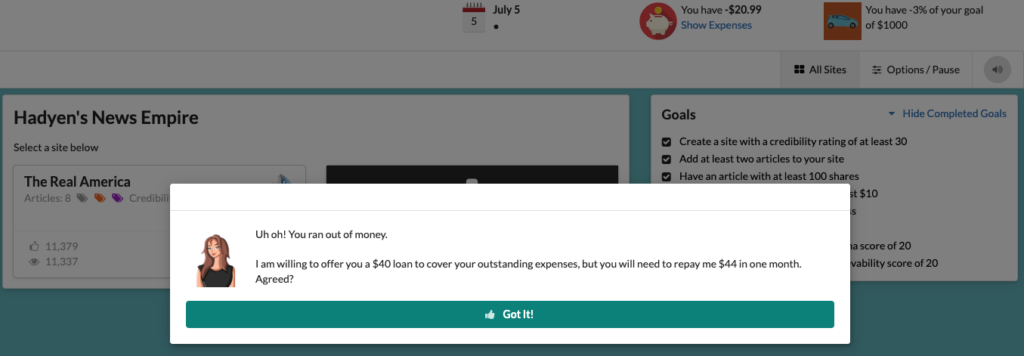
For the duration of gameplay, the operator is thus encouraged to pump out as many emotionally triggering articles as possible in order to generate revenue. Many of the next steps needed for success are prompted by that same money lender. As the player, you can acquire articles for social media monetization in two different ways; you can either copy another’s article and post, or write your own. The idea here is to post as many articles as you can while covering the most emotional responses possible, while meeting certain goals imbedded in the programming.
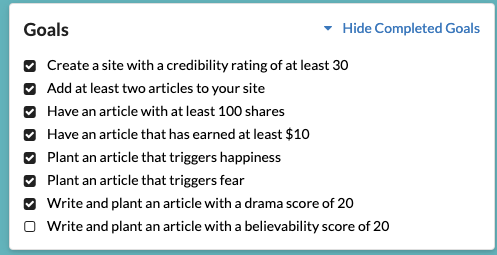
The educational effectiveness in “Fake it to Make it” exists in the platform’s ability to incentivize the user, who more than likely never considered why and how misinformation is being created, to experience both the monetary pressures and the morally flexible ease by which misinformation is propagated. Furthermore, while it won’t be able to eradicate misinformation, video games such as this one certainly create training regimens that exist in a motivational context that benefits the individuals ability to quickly identify (or transversely create) misinformation.
Leave a Reply